



The Kurdistan Region of Iraq (KRI) faces an internal crisis with potentially severe economic, political, and security ramifications. Patriotic Union of Kurdistan (PUK) leader Bafel Talabani announced his party's withdrawal from the KRI’s government, threatening to form a second administration in the PUK’s Sulaymaniyah stronghold, separate from the government in the capital, Erbil.
As the region risks becoming officially split into two separate administrations under the Kurdistan Democratic Party (KDP) and the PUK for the first time in 20 years, the US appears less inclined than in previous years to play a role in resolving the government crisis between the KDP and the PUK.
Adding to these challenges, the present political crisis could hardly come at a worse time. The region is still reeling from the Iran war. Furthermore, the US-led coalition has withdrawn its remaining air defenses and troops from Erbil.
The last straw in the government deadlock
PUK leader Talabani described the present situation as “the single largest political crisis in the history of the Kurdistan Region” in an interview with journalist Hadley Gamble on Thursday. He reiterated his refusal to recognize the KRI’s parliament in Erbil as legitimate. A week earlier, on November 5, he released a video message insisting the current cabinet has failed and slamming the KDP's effort to reactivate the parliament in Erbil after a two-year deadlock. “You are forcing us to react; whatever you do over there, we will do right here,” he declared. “You appoint a President of the Region, we will appoint a President of the Region. You appoint ministers, we will appoint ministers. You appoint a Prime Minister, we will appoint a Prime Minister.” He concluded his statement by declaring: “You started it, and I will finish it.”
The last parliamentary elections in the KRI were in October 2024. Out of the parliament’s 100 seats, the KDP won 39 and the PUK 23. The two leading parties couldn’t agree on who should get which senior government positions in the next cabinet. Kurdish media reported in October 2025 that the KDP offered the PUK the positions of parliament speaker, deputy prime minister, deputy president, and other ministries.
Meanwhile, in July, the PUK sought to combine its 23 seats with the New Generation party’s 15 to make 38, one less than its rival and it demanded half of the next cabinet. The KDP said it would deal only with the PUK and its 23 seats, insisting the positions allotted to the party should be commensurate with the election results.
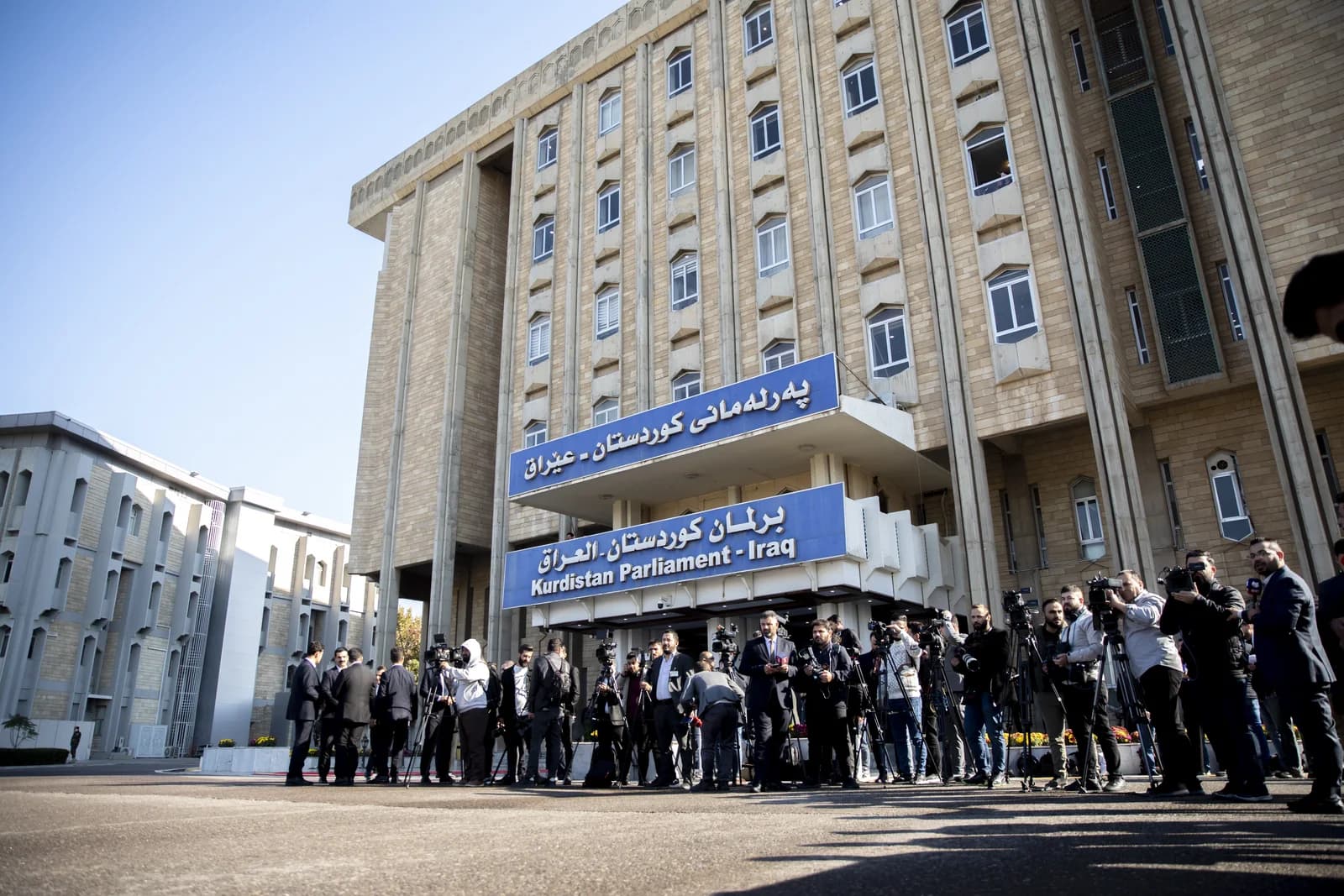
The day before Talabani’s message, the KDP convened a parliamentary session with lawmakers, minority representatives, and smaller parties to exceed the 51-member quorum by just one seat. They promptly elected a speaker, deputy speaker, and secretary. The PUK boycotted these proceedings, describing them as “illegal, far removed from the principles of genuine partnership, and it is an attempt to impose the will of a single party.” Then Talabani issued his message.
The largest crisis in the KRI’s history?
The PUK leader’s contention that the present political crisis is the “single largest” in the region's history is certainly debatable. The KRI established its first government in 1992, the year after the Persian Gulf War. While the KDP and PUK initially shared power, by 1994 the region descended into civil war, sparked by disputes over sharing customs revenues, which the KDP secured the lion’s share of largely thanks to its geographical proximity to Türkiye. Despite interventions by Iran and even Saddam Hussein’s forces, the war ended with neither side able to defeat the other and dominate the entire region decisively. The US helped negotiate peace with the 1998 Washington Agreement. The war ended with the KDP controlling Erbil and Duhok, and the PUK controlling Sulaymaniyah.
The subsequent 2003 Iraq War and the toppling of Saddam Hussein’s brutal regime saw the KRI’s fortunes dramatically change for the better. The isolation and civil war had finally ended. The Kurdish Peshmerga forces effectively shielded their homeland from the bloodshed and violence that plagued much of Iraq throughout the 2000s. The region’s autonomy was codified in the Iraqi Constitution. Marketing itself as the Other Iraq, the KRI encouraged foreign investment and even international tourism. It built modern international airports in Erbil and Sulaymaniyah, directly connecting itself to the outside world after decades of isolation.
In a promising move, the KDP and PUK formally agreed in 2006 to unify the region under one administration, with the parliament and government headquartered in Erbil. Another informal understanding was reached between KDP leader Masoud Barzani and then-PUK leader Jalal Talabani: the KDP would hold the KRI presidency; the Iraqi presidency would invariably go to the PUK. Both parties still retained separate Peshmerga forces, and internal checkpoints remained along the lines that had previously separated the two administrations.
Jalal Talabani passed away shortly after Barzani’s KDP initiated an independence referendum in September 2017 following the territorial defeat of Daesh. Iraq condemned the referendum and moved to punish the KRI. Shortly thereafter, Bafel Talabani released a video statement justifying the PUK Peshmerga’s imminent withdrawal from the disputed region of Kirkuk, which Iraq promptly captured on October 16. Kirkuk’s deposed PUK Kurdish governor, the late Najmaldin Karim, charged that “treasonous” elements within his party colluded with Iran to surrender his city. Those October events marked a particularly low point in KDP-PUK relations, arguably even representing “the single largest political crisis” between them since the civil war itself up until that point. Still, it didn’t lead to renewed hostilities.
In the years that followed, the two leading Kurdish parties repeatedly failed to form anything resembling a united front to represent the KRI’s interests in Iraq’s parliament, instead throwing their support behind rival factions. The KDP sought the Iraqi presidency traditionally held by the PUK. In the KRI, the PUK campaigned in the 2024 election, among other things, to restore Erbil “to its original inhabitants.”
Despite support from the US-led anti-Daesh coalition, Peshmerga reunification progressed at a snail’s pace, with the majority of Peshmerga under partisan control of the KDP and PUK rather than under the KRI’s Ministry of Peshmerga. The last US troops, redeployed in Iraq in 2014 to help the Iraqi Army and Peshmerga combat Daesh, left by September 30 under a prearranged 2024 phased withdrawal plan. Earlier that month, the Ministry of Peshmerga announced that it had brought the partisan KDP and PUK’s 70 and 80 Forces Peshmerga under a unified command and control. It inaugurated the First and Second Area Commands in a clear bid to project confidence ahead of the US withdrawal.
The withdrawal raised security-related concerns in the KRI. Prime Minister Masrour Barzani warned of the region’s exposure to drone and missile attacks from Iran and Iraqi militias following the pullout of US air defenses from Erbil. Masoud Barzani has also warned of a potential Daesh resurgence in the withdrawal’s wake, as happened after the previous US troop pullout in 2011.
The road to breakup is fraught with risks
Aside from security issues, the US seemingly has little interest in arbitrating internal Kurdish disputes, at least not to the same extent it did in the late 1990s. As US Special Envoy for Syria and Iraq Tom Barrack bluntly put it on November 11, the US role “is to not confuse the direction of Iraq being Iraq.” “My advice, the [US] president’s advice, is get over it,” he said. Later in the same speech, he reiterated that stance while underlining the need for regional unity and unity between the KRG and Iraqi government.
Shortly after Masoud Barzani called for dialogue to resolve the disputes, which he dismissed as “an old trick,” Talabani argued that the reality of the region is one of two governments and two administrations but didn’t rule out an eventual settlement. Talk of two governments was “jumping the gun,” he said in his Thursday interview with Gamble. “I try to make it very clear to the KDP that every escalation will be met with an appropriate and well-planned escalation,” he added. “To me, that means the door is open for us to stop escalating and start dialoguing. But be certain the escalation ladder is here.”
Any escalation resulting in an official, unmistakable fragmentation of the KRI into two separate, rival administrations could prove utterly disastrous. Baghdad could use a fragmented KRI as an excuse to bring the region’s autonomous status to an end. A few months after the independence referendum and October events, Iraqi Prime Minister Haider al-Abadi campaigned in Erbil. He sought to convey that the region’s autonomy was finished and that it should be treated no differently than other federal Iraqi provinces. His message was unsurprisingly unpopular among Kurds.
If the KRI becomes divided into two separate administrations, that could embolden and empower future Iraqi leaders who seek to dismantle its parallel autonomous governmental institutions. For a decade, Baghdad has gradually weakened the KRI’s ability to sustain itself by withholding salaries for its public sector employees, reducing the KRI’s share of the federal budget, and ending its independent oil exports. If KRI officially reverts to separate administrations, Iraqi leaders could argue that the KRI’s autonomy is de facto null and void, since it would no longer have a single recognized constitutional regional government.
Of course, it’s still possible, perhaps even most likely, that the region can and will pull itself back from the brink. It can ill afford not to.