


Six months after taking office, Iraqi Prime Minister Ali al-Zaidi is beginning to discover that holding the premiership and having the ability to control weapons are two entirely different matters. His government has made disarming Iran-aligned factions its central commitment, particularly following his first visit to the United States.
The credibility of the Iraqi state has increasingly become tied to its ability to deliver on this pledge. So far, however, the results have been mixed: there has been some progress on paper and in official statements, but resistance continues on the ground, while Washington and Tehran closely monitor the course of this issue.
Where does the process stand?
Al-Zaidi assumed office in May 2026, pledging not to tolerate the existence of a “state within a state.” His initial objective was to bring weapons under state control by September, coinciding with the completion of the withdrawal of American forces. However, resistance from the factions obstructed the process, forcing him to extend the deadline until 30 June 2027. One of the government’s advisers later acknowledged that no final agreement would be reached during the current year.
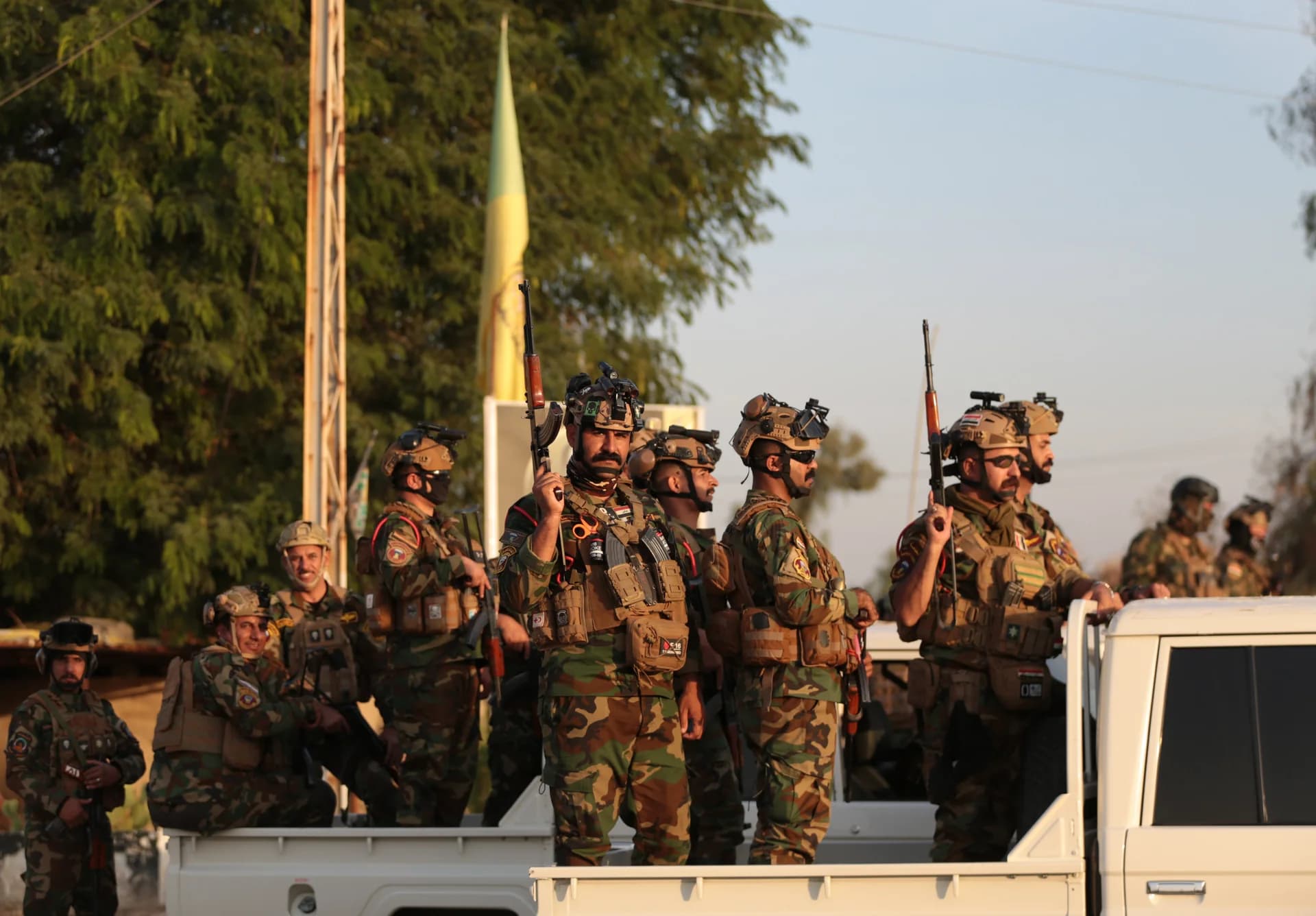
The official position appears optimistic. A government spokesman announced that five armed groups had agreed to place their weapons under state authority, while negotiations were continuing with two others. Iraqi Foreign Minister Fuad Hussein also revealed in media statements that Asaib Ahl al-Haq and Kataib Sayyid al-Shuhada had agreed to arrangements for restricting weapons, while negotiations with Kataib Hezbollah and Harakat al-Nujaba were ongoing in an effort to reach an agreement.
However, despite the optimism expressed in official statements, the two factions have reiterated their commitment to retaining their weapons, adhering to the doctrine of the “unity of the arenas,” and remaining prepared for battle should Iran come under attack in the future. This directly contradicts al-Zaidi’s efforts to restrict weapons and keep Iraq out of the regional conflict.
Obstacles to disarmament
For months, the Shia Coordination Framework has been responsible for negotiating with armed factions. However, reports published in early November indicate that al-Zaidi sidelined the Framework’s negotiating committee after rejecting a written understanding that included conditions and a timetable for the process.
Field information also indicates that some factions claim to be complying with government decisions while, in practice, relocating weapons depots, transferring weapons to groups that refuse to disarm, or registering weapons under multiple names and factions. This suggests that these groups are not genuinely committed to the weapons restriction process and instead view the current developments as a temporary and turbulent situation to which they must submit only for the time being.
Other information has confirmed that faction leaders informed the Prime Minister that their willingness to disarm depends on whether war between the United States and Iran resumes. This reveals the essence of the problem: these groups regard their weapons as a strategic guarantee for Iran rather than an internal Iraqi matter subject to the authority of the state.
Jurf al-sakhar: testing pressure on the most hardline faction
The significance of Jurf al-Sakhar becomes particularly clear in this context. Since its recapture from Daesh in 2014, the area, located south of Baghdad, has become a closed stronghold for Kataib Hezbollah, while its original residents remain displaced to this day.
According to a classified intelligence report published alongside discussions about bringing weapons under state control, 105 fuel tankers were identified at four concealed locations inside the area. The findings were based on satellite imagery and confirmed field sources. The report also concluded that oil had been siphoned from state-owned pipelines since 2021.
The government’s focus on this location appears deliberate, as does the timing of the report’s leak. Baghdad is attempting to tighten financial and economic pressure on armed factions, particularly Kataib Hezbollah, following a media confrontation and mutual accusations between figures close to al-Zaidi and the faction’s leaders and media personalities.
Last Friday, an investigative committee entered Jurf al-Sakhar accompanied by Federal Police and army forces, the first state presence inside the area in 12 years, though Kataib Hezbollah fighters insisted on vetting the photographer before allowing cameras in. The standoff has since escalated. On Monday, a government spokesman said al-Zaidi had ordered troops into the area and given the group a deadline to leave, reportedly expiring at the end of this week. Kataib Hezbollah warned Iraqi forces against entering, and the Coordination Framework, reportedly divided, began mediating.
These developments can be viewed positively as part of a gradual strategy that begins by exposing the illicit economy before moving towards direct confrontation. A more pessimistic interpretation, however, suggests that state authority still ends at checkpoints controlled by the factions. Either way, Jurf al-Sakhar will be the place where the seriousness of the disarmament project is ultimately tested.
Cutting off sources of funding: border crossings
The economic dimension represents a second pressure point on the factions. Armed groups have accumulated considerable financial influence through customs revenues, smuggling and commercial contracts. Depriving them of these sources of income could therefore force them to reconsider their positions.
Al-Zaidi has moved on several fronts, cancelling contracts linked to armed factions at Mosul airport, a step described by US envoy Tom Barrack as “an actual exercise of sovereignty.”
Following the launch of drones from Iraqi territory towards Saudi Arabia’s East-West pipeline in September, al-Zaidi ordered the closure of border crossings with Iran, although three of them were reopened within days.
On 21 October, the strategically important Al-Sheeb border crossing was closed by direct orders from the Prime Minister, amid reports that the US Treasury Department had raised the issue with him. This month, Al-Sheeb was reopened following a security review and the installation of detection equipment, while the Mandali crossing was temporarily closed for reasons described by the authorities as technical.
Although official explanations refer to technical and security considerations, the broader pattern is clear. Iraq has eight land border crossings with Iran, while bilateral trade exceeded $10 billion last year. This means that controlling these crossings also means controlling one of the country’s most important sources of financial revenue.
Washington and Tehran: how do they view the situation?
The United States is exerting considerable pressure on al-Zaidi’s government regarding the militia disarmament process, with reports indicating that Washington has threatened financial sanctions or even military strikes. Despite the significance of this pressure, Baghdad’s appearance as though it were implementing American dictates could give the factions an opportunity to portray themselves as defenders of national dignity and sovereignty.
For this reason, Baghdad’s policy must be seen as Iraqi in both origin and decision-making.
Iran, meanwhile, has little incentive to abandon its most important regional instruments of influence as long as its confrontation with Washington remains unresolved. Tehran is attempting to manoeuvre and avoid being forced to choose between its economic influence and its armed proxies inside Iraq. It is therefore seeking to buy time, delay the process and keep the government occupied with forming committees and conducting negotiations for as long as possible.
Success, failure and the next test
Even partial success in this process would restore the state’s legitimate monopoly over the use of force, reassure Gulf countries and investors, and prevent Iraq from becoming an arena for settling scores in regional conflicts.
But the failure would mean that armed factions continue to exercise an effective veto over government decisions, exposing Iraq to military strikes whenever regional tensions escalate, deepening its financial isolation and reinforcing the belief among future governments that promising reform is far easier than implementing it.
On the other hand, three indicators will reveal how serious this process really is: publishing lists identifying the factions that have disarmed, establishing independent mechanisms to verify weapons handovers, and imposing real consequences on those obstructing the process.
Jurf al-Sakhar and the border crossings will be the most important arenas in which to test these indicators.
Every Iraqi prime minister since 2005 has pledged to restore the state’s monopoly over weapons. Yet all have encountered the gap between political rhetoric and the reality of armed arsenals, a gap in which national sovereignty continues to be lost.