Türkiye is experiencing a critical turning point in the resolution phase of one of its core issues spanning over 40 years. As of late 2024, a new initiative began toward resolving the long-standing conflict with the PKK in Türkiye. Following the remarks made by Nationalist Movement Party (MHP) leader Devlet Bahçeli from the parliamentary rostrum on October 22, 2024, significant progress has been made over the past 21 months. While developments within Türkiye continue on the one hand, regional developments can also influence the course of the process.
In this context, another focal point of attention is the territory controlled by the Kurdistan Region of Iraq (KRI). The fact that the PKK’s main deployment areas are located in northern Iraq has made the "Terror-Free Türkiye" process an equation that cannot be limited solely to the Ankara-İmralı-Qandil axis from day one. As the natural actor of this equation, the Erbil and Sulaymaniyah fronts within the KRI are contributing to the process at varying scales.
The Facilitating Position of the KRI
The role assumed by the KRI in the "Terror-Free Türkiye" process has stood out through practical contributions on the ground, alongside statements at the party and leadership levels. Due to the fact that a large portion of the PKK’s main deployment areas are located within its territories (particularly Qandil and its surroundings, as well as the Sulaymaniyah region), the KRI stands as a directly affected actor. This geographical reality makes the KRI both a potential mediator and one of the parties most affected by the success of the process.
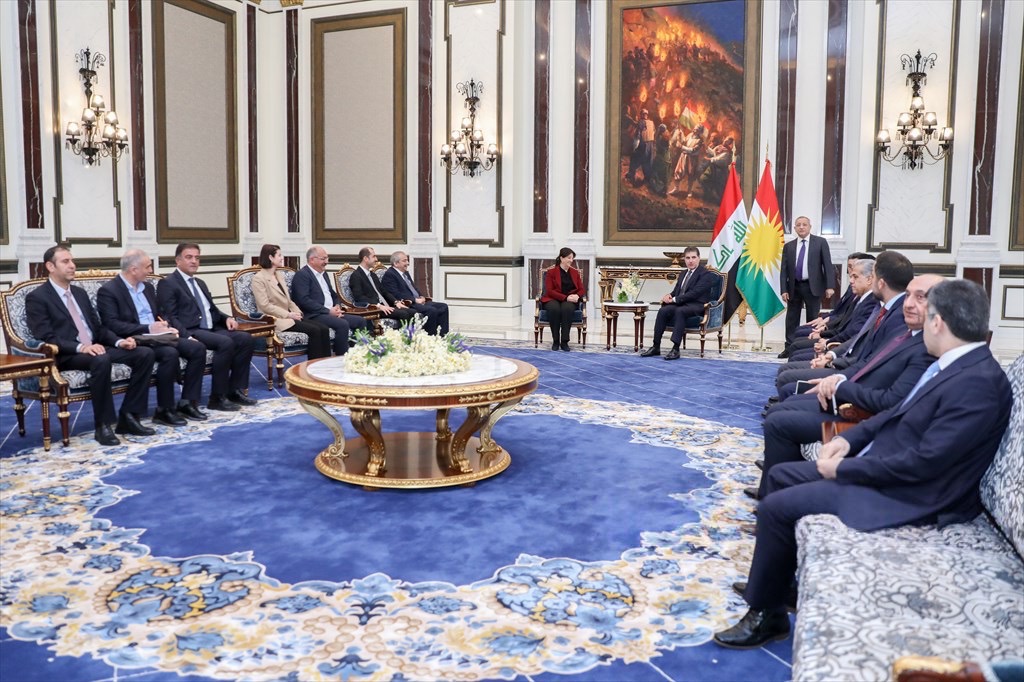
To explain with a brief chronological cross-section, the process was shaped by the statements made by Abdullah Öcalan from İmralı following MHP Chairman Bahçeli’s calls, and the dissolution and disarmament decisions taken by the PKK at its 12th Congress held in May 2025. In the KRI, leaders made supportive statements from the very beginning of the process. The DEM Party’s İmralı delegation, an important actor in the process, visited Erbil and Sulaymaniyah between February 16–19, 2025, holding a series of meetings with Kurdistan Democratic Party (KDP) President Masoud Barzani, KRI President Nechirvan Barzani, and Patriotic Union of Kurdistan (PUK) leader Bafel Talabani. During the same period, KDP leader Barzani also hosted both the İmralı delegation and Kurdish parties in Türkiye, giving open support to the process. Masoud Barzani’s emphasis that those wishing to sabotage the peace process in Türkiye must not be permitted was interpreted as a clear message of support for the uninterrupted continuation of the process.
KRI President Nechervan Barzani described the peace process in Türkiye as a "historic opportunity" in his statement in April 2025, noting that all parties—especially the PKK—must fully comply with Öcalan’s call. Stating that " We must not miss this opportunity," Nechervan Barzani called for the process to be handled with seriousness. In meetings held between KRI Prime Minister Masrour Barzani and President Recep Tayyip Erdoğan on various dates, issues of regional stability and counterterrorism were addressed; these contacts provided coordination to advance the process. The entire political spectrum in the KRI (led by the KDP and the PUK) expressed open support for the process across various platforms.
The first concrete step of the process was the symbolic disarmament ceremony held on July 11, 2025, in the Dukan region of Sulaymaniyah within the KRI. At the ceremony, approximately 30 PKK members symbolically burned their weapons. The ceremony was recorded as the most concrete example of the logistical and security support provided by the KRI to the process. The DEM Party delegation was welcomed by KRI officials upon landing in Erbil, and their transportation to Sulaymaniyah was also organized by them. The participation of representatives from both the KRI and the Iraqi central government in the ceremony demonstrated the KRI's capacity to act in coordination with both Baghdad and Ankara. Furthermore, the fact that the ceremony took place in KRI territory revealed that the PKK's commitment to disarm was accepted by regional actors and made logistically feasible.
Alongside the developments unfolding in the process, contacts between Ankara and Erbil continued with full intensity. Nechervan Barzani held contacts with President Erdoğan and other regional actors on April 18, 2026, during his visit within the scope of the Antalya Diplomacy Forum. Masrour Barzani met with President Erdoğan in Istanbul on May 9, 2026; he also came together with Minister of Foreign Affairs Hakan Fidan. Türkiye–KRI relations, Iraq, and regional developments were discussed during the meetings.
On the field side, the organization had announced that it completely withdrew from Türkiye on October 26, and after a 1-month period, it shared the information that it had also departed from the Zap region.
Why is Erbil contributing to the process?
One of the motivations behind the KRI's positive stance achieved with Türkiye is that ensuring regional stability and security will also benefit Erbil and Sulaymaniyah. We can formulate these goals, which we can address under different headings, as follows:
At the forefront of the most important factors lies the direct cost of the PKK's presence. The Qandil, Zap, Metina, and Gara line, where the organization is deployed, have been regions where the KRI's official authority has practically not functioned for years. This situation, on the one hand, made the regional administration the addressee of Türkiye's cross-border operations, and on the other hand, caused it to experience clashes with the organization. The liquidation of the PKK's armed presence will mean the KRI regaining control over its territories.
Secondly, it will consolidate the leadership in Kurdish politics. Erbil's ownership of the process enables it to position itself as the "address that solves the problems of the Kurds through politics rather than weapons." This strengthens Erbil's hand both in its ongoing historical rivalry with the Öcalan faction and in the eyes of the international public.
Thirdly, economy and energy. Türkiye is the KRI's main gateway to the outside world and its largest commercial partner. The shrinking of the security agenda paves the way for energy and transportation dossiers. Especially for the energy policies that have gained momentum on the Türkiye and Iraq line recently, the KRI will constitute one of the legs of cooperation opportunities. Moreover, the "Terror-Free Region" vision will play a facilitating role in overcoming the financial problems that occasionally come to the agenda between the Iraqi central government and the KRI.
Another important gain will be the contribution towards overcoming regional vulnerability. The transformation in Syria, chronic problems between Erbil and Baghdad, tensions on the Iran line, and Iraq being directly affected by this push the KRI to further strengthen its relations with Ankara. Indeed, when Erdoğan received KRI Prime Minister Mesrur Barzani in May 2026, he emphasized that they did not want conflicts to spread to the region and that solidarity with the KRI administration would continue throughout this process.
From the perspective of the KDP, the process is a natural extension of the already strong relationship with Ankara. The Erbil-based party is an actor that has experienced direct tension with the PKK in the past and has acted in harmony with Türkiye in the field of security; therefore, the disarmament of the organization overlaps with the KDP's long-term preference.
Ankara-Sulaymaniyah Normalization
The most notable side effect of the process was the thaw in relations between Ankara and the KYB, which had been strained for some time.
The breaking point occurred in the autumn of 2025. The airspace that Ankara had closed to Sulaymaniyah in the spring of 2023, citing the PKK’s presence in the region, was reopened following Nechervan Barzani's visit to Ankara in October 2025, and Turkish Airlines resumed flights to Sulaymaniyah as of November 3, 2025. This step, which appeared technical, was actually a renewal of political trust.
Normalization on the Ankara-Sulaymaniyah line accelerated in 2026. Türkiye's Ambassador to Baghdad, Anıl Bora İnan, met with the PUK leadership during his visit to Erbil in June 2026. Subsequently, MIT (National Intelligence Organization) Chief İbrahim Kalın traveled to Sulaymaniyah on July 1, 2026, meeting with PUK leader Bafel Talabani and the KRI's PUK-affiliated Deputy Prime Minister Qubad Talabani; two days later, Foreign Minister Hakan Fidan received Qubad Talabani in Ankara, where Talabani expressed his satisfaction with Ankara's commitment to the peace process. The relationship, whose diplomatic dimension normalized at the embassy level, was thus repaired in its security dimension with Kalın's visit.
There is also a Kirkuk dimension to this rapprochement. In April 2026, as a result of the new post-election alliance strategy established by the KYB, Muhammad Seman Aga, chairman of the Iraqi Turkmen Front, was elected governor of Kirkuk—the first Turkmen to hold this position in 102 years. This move, taken in a matter of great sensitivity to Ankara, indicates that the KYB seeks to rebuild its relations with Türkiye not only through the PKK issue but on a broader basis.
In conclusion, the KRI’s support and facilitating role in the "Terror-Free Türkiye" process manifested themselves through steps—ranking among the most concrete outcomes of the process thus far—taking place in northern Iraq. The support of political parties and leaders in the KRI for the process stems not only from strong relations with Türkiye, but also from the perception of the process's potential success as a crucial threshold for the security, development, and prosperity of the KRI.
However, the possibility of a deadlock in the process could yield negative consequences for the KRI, which has demanded the termination of the organization's presence in the region for many years. Therefore, it can be assessed that the region's strong support for the "Terror-Free Türkiye" process will continue. Undoubtedly, on a terror-free foundation where a new page is turned, cooperation between actors in the region and social peace will be further strengthened.