


A roughly three-hour drive separates Erbil and Sulaymaniyah on the map, but amid discussions of a return to dual administrations, the political distance between the strongholds of the two ruling Kurdish parties has perhaps grown wider than at any point since their civil war of the 1990s.
The Erbil-based Kurdistan Democratic Party (KDP) and the Sulaymaniyah-based Patriotic Union of Kurdistan (PUK) managed to keep the Kurdistan Region of Iraq (KRI) out of the Iran war despite the devastating missile and drone attacks it endured during conflict. Yet, amid the deepening government crisis that has unfolded since the October 2024 elections, the two parties now appear unable to shield the region from threats emerging from within.
In fact, the rising tensions that have led to the current government deadlock have been clearly visible in the KRI. But allowing these divisions to spill over into Baghdad, where Iraqi Kurds have never managed to present a lasting united front and have faced punitive measures from the central government for the last decade, could have devastating consequences for the region.
The source of the government crisis and the division debates
On 4 November, the KDP reactivated the KRI’s parliament despite the PUK’s objections, reaching a quorum of 52 MPs with the help of minority-quota representatives, small-party members and MPs who broke ranks with the PUK and New Generation Movement. The next day, PUK leader Bafel Talabani declared the session illegitimate and withdrew his party from the KRI government. He has also threatened to set up parallel institutions in PUK-controlled areas if the KDP proceeds with unilateral appointments, although he has described talk of two governments as premature and ruled out violence.
The split follows almost two years of government formation paralysis after the elections in which the KDP won 39 seats, the PUK 23 and the New Generation 15. In July, the PUK and New Generation signed an alliance that combines their 38 seats and commits them to coordinated positions in both parliaments in Erbil and Baghdad.
At this point, the deadlock over the balance of power between the two parties, with the PUK demanding half of the cabinet and the KDP only willing to give its rival a share of power proportionate to its electoral performance, has pushed the region into what may be its second-largest crisis since the civil war of the 1990s.
Therefore, the current crisis clearly goes beyond the latest elections, reaching back to the power-sharing arrangements the KDP and PUK agreed on in 2006, which began to unravel around 2013 as the PUK started losing electoral support. While the PUK wants to remain an equal and influential partner in governing the region, as it was during the era of Jalal Talabani, the KDP seems committed to approaching its rival in proportion to its electoral strength, given that the PUK now holds around half as many parliamentary seats as the KDP.
Yet anyone who has visited the KRI can see that, despite a single parliament and united government, regardless of the parties’ respective vote shares, their influence over governance, security and economic affairs becomes evident from the moment one passes through the checkpoints in the territories they control. And this is where the real problem begins. If a government is formed by either party while excluding the other would be unworkable, whether in Erbil or Sulaymaniyah, risking forcing the region into an official division. This is precisely the scenario the PUK has now brought into play.
Of note, following the Federal Supreme Court’s ruling on the KRI’s election law, the KDP’s boycott of the 2024 elections had also raised similar concerns, although that scenario ultimately did not materialize. It was equally clear that an election held without the KDP and a government formed in its absence would be just as unworkable, given that the KDP is the region’s largest and most powerful party.
Kurdish divisions were already undermining their influence in Baghdad
Despite statements from both the KDP and the PUK suggesting that they are willing to give negotiations a chance, neither party has taken any decisive steps to ease the current crisis. Meanwhile, neither the US nor regional countries appear to have made any visible or serious effort to mediate. US Special Envoy Tom Barrack’s warning to the Kurdish leaders to “get over it” and strengthen coordination with Baghdad is a clear example.
In the meantime, the growing crisis of Iraqi Kurds is offering Baghdad an advantage at a time when the Iraqi capital is already struggling with militias undermining state sovereignty and the need to navigate the delicate balance between the US and Iran. Rather than presenting a united front in Baghdad to recover the ground they lost after 2017 independence referendum, Iraqi Kurds are further jeopardizing their already eroded position in Baghdad, despite the crises facing the federal government.
In that, in the aftermath of the referendum, when the Kurdish parties traded accusations of betrayal, the Iraqi federal government captured the city of Kirkuk. Since then, Iraqi central governments have steadily eroded the region’s leverage over key issues such as the KRI’s electoral law, budget share, delays in public-sector salaries and termination of independent oil exports.
In the following years, the KDP and the PUK have only partially coordinated in negotiations with Baghdad over the region’s entitlements. The two parties have also competed for federal posts and have at times backed rival blocs in the Iraqi capital. In 2022, the KDP also aligned with the Sadrist Movement and Sunni parties while the PUK allied with the Shia Coordination Framework. Furthermore, the election of Iraq’s president, a position traditionally held by a Kurd, shows that the KDP and PUK are struggling even to agree on a joint presidential candidate in Baghdad since 2018. Most recently, the KDP opposed the process that led to the election of PUK’s Nizar Amedi this year, declaring that it would not engage with him.
Baghdad’s response and what could come next
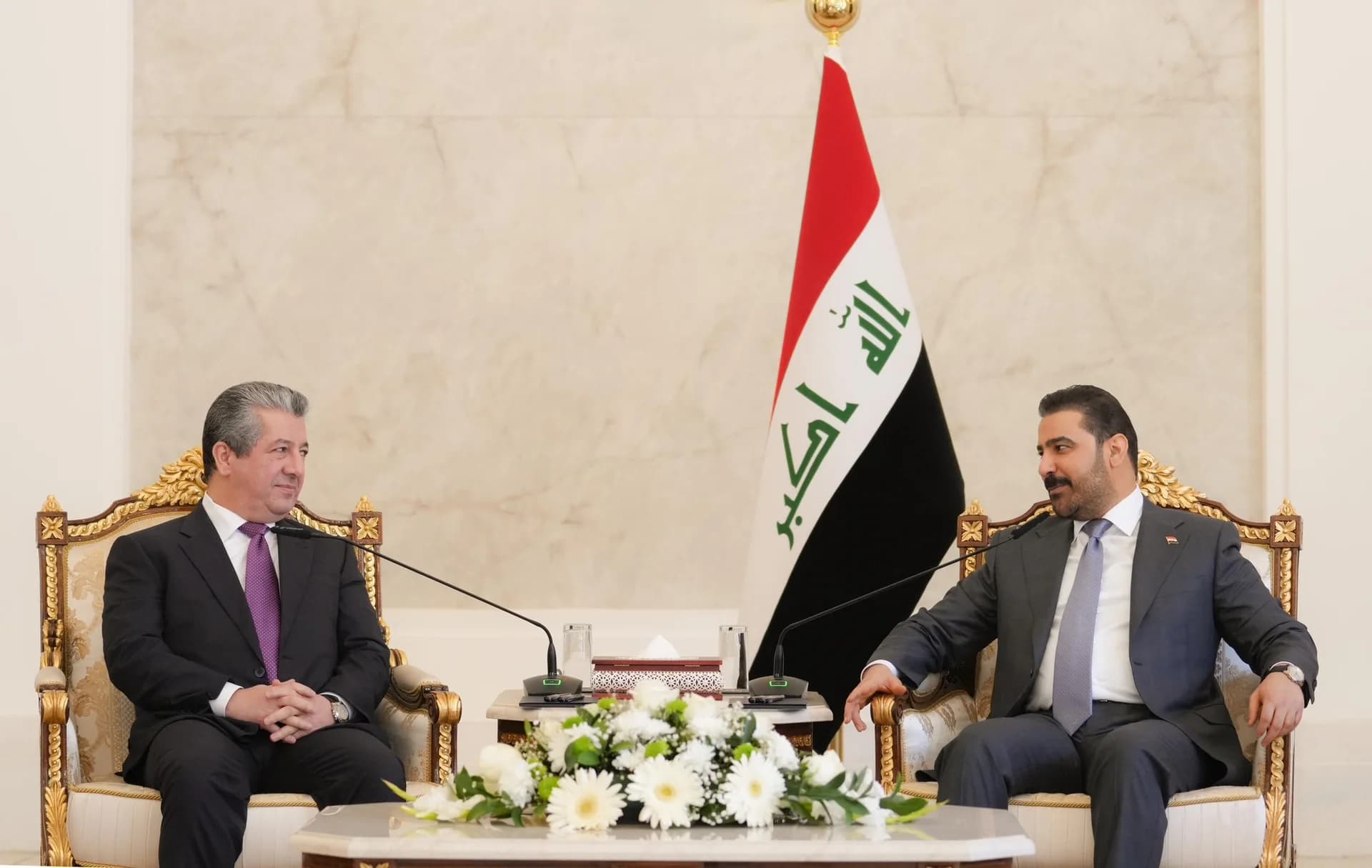
Although KRI Prime Minister Masrour Barzani, PUK leader Bafel Talabani and New Generation leader Shaswar Abdulwahid have visited Baghdad following the internal crisis in the KRI, none of them has managed to persuade Baghdad to take a side. However, Barzani’s statement after his meeting with Iraqi Prime Minister Ali al-Zaidi that Baghdad will allocate the 2027 budget to the KRI as a “unified region” suggests that the federal government is, at least initially, unwilling to engage in the division debates. Talabani and Abdulwahid’s contacts with Shia politicians, meanwhile, have not produced any clear, visible support for the Sulaymaniyah side.
Although making Sulaymaniyah and Halabja a separate region or turning them into Iraqi provinces would not generate a positive public image for the PUK among the Kurdish population, despite the KDP’s part in the deadlock, Baghdad could raise either option as part of its efforts since 2017 to weaken the status of the KRI.
So far, Baghdad has avoided taking sides in the dispute over the KRI parliament and division debates. The Federal Supreme Court rejected a PUK and New Generation request for an injunction to halt the reactivation of KRI parliament. However, that does not mean Baghdad backs the KDP or opposes the PUK but it also has its own reasons not to be seen interfering the region’s current issues in terms of division. As a KDP official has warned, allowing a separate region from KRI may trigger similar demands in Iraq such as Basra, Anbar and Mosul, to the detriment of the Baghdad government.
Despite the fact that the Iraqi Constitution does not clearly address the secession from an already recognized region, some actors within Iraq may favour a split in the KRI, and even bringing such discussions to Baghdad could clearly be used as leverage against Erbil. Obviously, the less these discussions feature in Baghdad, the stronger the KDP’s hand will be in any future negotiations with the PUK over forming a government in the KRI, while the opposite is true for the PUK. Baghdad’s stance on discussions about a possible split in the KRI will also serve as a test of its close ties with the PUK and its more distant relationship with the KDP.
Against this backdrop, the New Generation leader Abdulwahid said that the PUK and New Generation weigh three options: a separate Sulaymaniyah budget from Baghdad, a return to two administrations, or two regions. But KRI PM Masrour Barzani stressed that the KRI “will not be divided”.
While the Iraqi Kurds are demanding that Baghdad increase the KRI’s 2027 budget share from 12.7 to 14.1 percent based on the population census, Sulaymaniyah’s pursuit of a separate budget from Erbil could not only undermine the region’s prospects of securing a larger share but also risk reducing its existing allocation even further. In fact, one Kurdish MP says three months of negotiations have produced no progress and the bill has been postponed indefinitely, warning that Baghdad parliament could pass it without Kurdish consent.
Now that the prospect of partition has entered the debate at such a high level, it will remain a pressure point for successive governments in Baghdad whenever they need a bargaining chip against the KRI. When the two main parties cannot agree on the structure of their own government and administration at home, Baghdad can exploit competing Kurdish demands in talks between the regional and federal authorities. This would give the central government upper hand over financial and security affairs, border management, oil and gas and the constitutional provisions.
Additionally, if the Kurds fail to resolve their current domestic crisis, it would be safe to say that their divisions over the posts allocated to Kurds in Baghdad, and over their positions within the federal government, will even deepen further.
The fact that the Iraqi Kurds, who once sought international support for an independence referendum, are now closely watching Baghdad’s stance to ensure their region does not split further, sums up just how much infighting at home has weakened their position in the Iraqi capital.
In the end, the drive between Erbil and Sulaymaniyah still takes the same amount of time. What remains unclear is whether the political road between the two will continue to lead to Baghdad as one, or begin to split in two. That choice belongs to Iraqi Kurds.